
The control of fire is arguably mankind’s most important learned skill. Yet …
…Yet, we humans are still at the mercy of fire (natural or otherwise), which, when uncontrolled can obliterate not just forests, but whatever gets in the way, such as houses, infrastructure and even whole towns and communities.
So, we take notice.
And we wonder if wildfires are getting more frequent or are we just noticing them more because of the 24/7 global news cycle made steroidal with the advent of social media.
As geologists know, our human-scale time perspective is small, limited and biased. Thus, a theme in research over the last half decade or so, is trying to understand the frequency of wildfires, their causes and their location (in time and space) from the present to the past hundreds of millions of years.
Peat (modern or geologically ancient) is a material especially good at recording – and preserving- the presence of fire, it’s frequency and perhaps even the temperature at which that fire burned at. Peat preserves charcoal very well and identifying burn layers is a way to account for fire frequency. Measuring the light reflectivity of the charcoal (using a microscope) also may give an indication of the temperature at which the fire burned.
I’ve been privileged to be a member of a study on paleopeat mires (aka coal) from the Early Cretaceous of Inner Mongolia, published in Communications: Earth & Environment*. In the study, the main goal was to estimate fire temperature from charcoal (or ‘fusinite’ as it is called in coal) throughout the thickness of the coal seams.
Most studies like ours, though, use a single derived formula to estimate fire temperature. That formula comes from a single study conducted over thirty years ago and is probably used because it published a formula for converting charcoal reflectance into temperature.
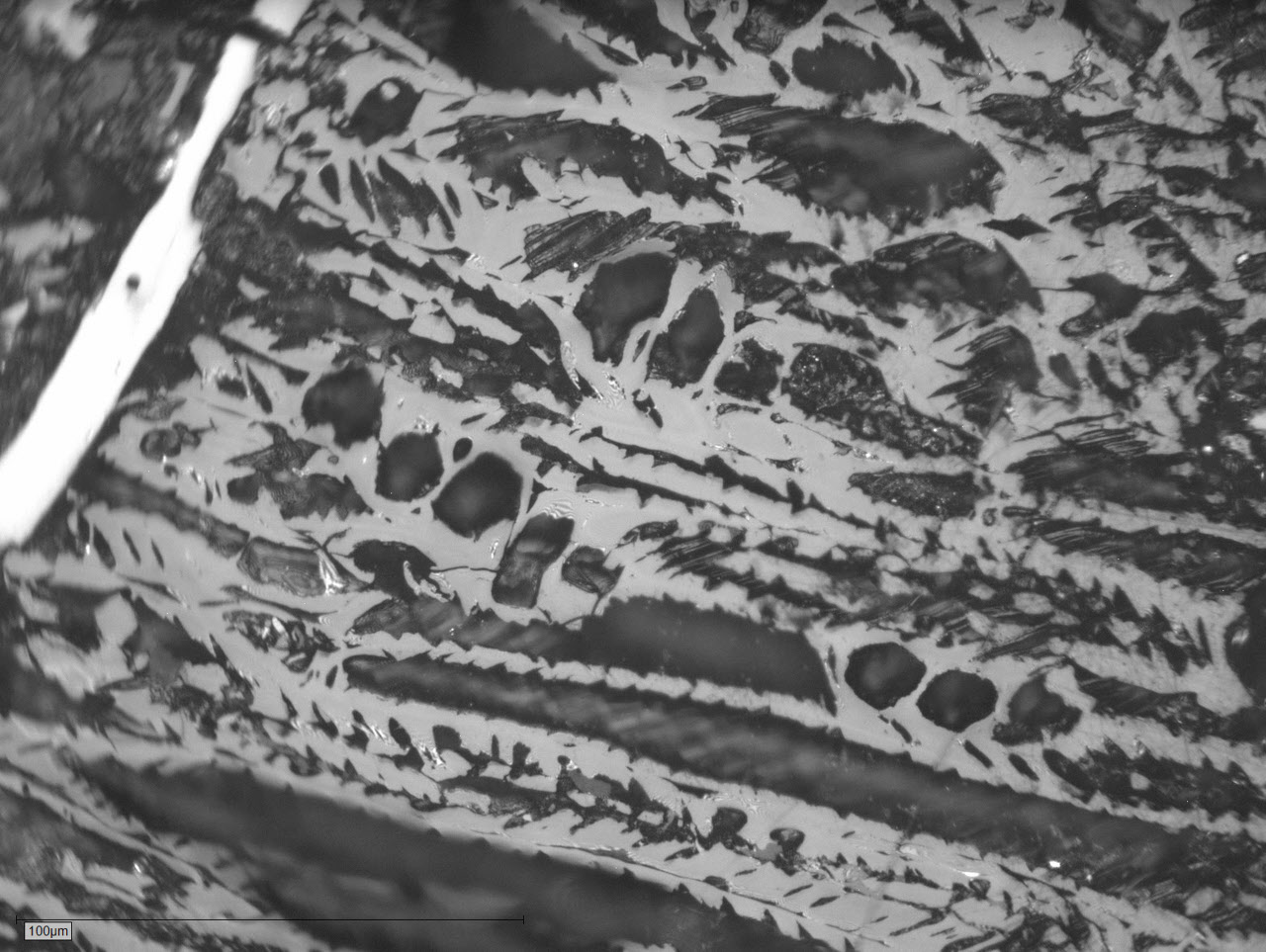
Fossil charcoal (fusinite) from Inner Mongolian Early Cretaceous paleopeat (aka coal).
Several studies have since been conducted replicating this initial study but on different plant types, parts and conditions. As you may well imagine, there is considerable variance in reflectance versus a single temperature (or vice versa) when comparing between these studies.
For charcoal fragments found in coal, it is virtually impossible to tell the plant type, or whether it is a root, stem or part of the trunk. Still, most studies just use that one formula.
We felt using such an approach does not result in any kind of statistical robustness.
So to remedy this, we derived formulas for estimating temperature from reflectance from 11 studies and applied each formula to each measurement made on every sample. This resulted in tens of thousands of estimates for each site and usually between 1100 to 1200 temperature estimates for each sample; thus, making a very robust statistical estimate of the temperature of formation for the fossil charcoal (i.e. fusinite) in each and every sample. Not just a single point with no way of telling what the variance (and error) might be.
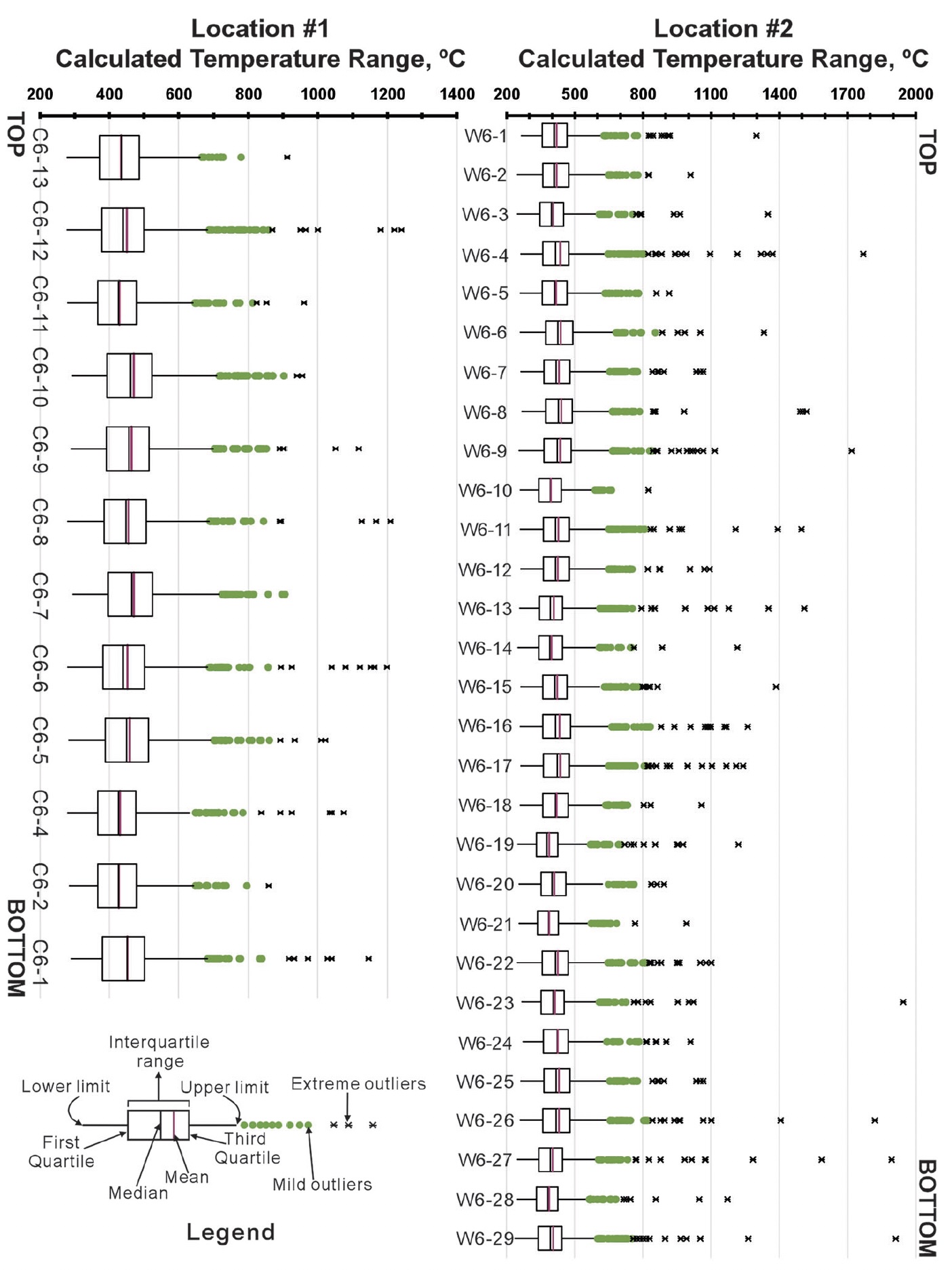
Box plots of estimates for fire temperature from each sample.
Our findings? Have a look at the paper (link below or ask me for a reprint) but like most peat fires, they were likely smoldering fire types with temperature ranges averaging in the low to mid 400ºC.
*Gao, Y., Moore, T.A., Liu, J., Dai, S. Peat wildfires during the Early Cretaceous Aptian–Albian of the Erlian Basin in Inner Mongolia, China. Commun Earth Environ 6, 987 (2025). https://doi.org/10.1038/s43247-025-02946-2


Comments are closed.